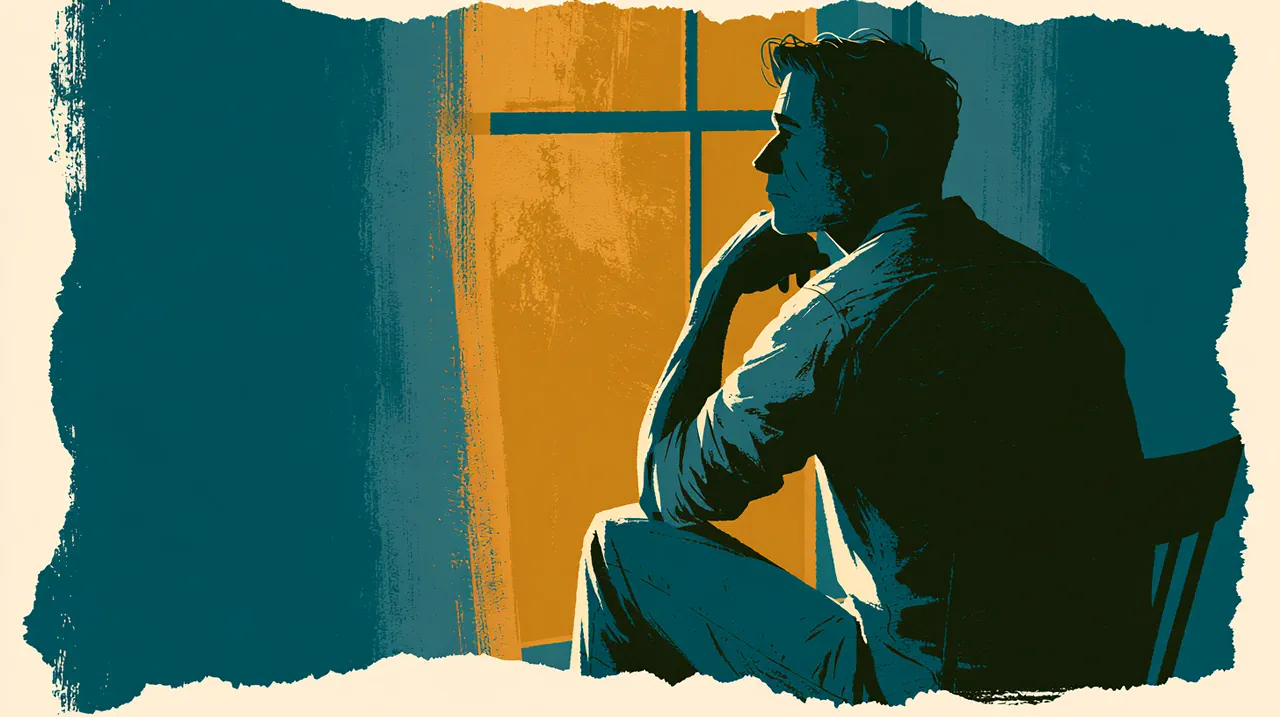
Do you recognize yourself?
"Is this what my life is going to be like – until I retire?" On paper, a lot of it makes sense. And yet, there you are on Sunday evenings, sensing that the answer is "not quite yet". So what next?
Everyone else is making progress? Engaged, promoted, moved abroad, settled in. But for you: the same question for months now, and the feeling that you’re the only one still figuring out what’s next.
You’re doing well – and yet it still doesn’t add up? The years have been invested, the responsibilities are mounting, and somewhere between two appointments, it pops up: “Is this what it’s all for?” Not as a breakdown. As a quiet, persistent “Is this what it’s all for?”
You know something has to change – but every option feels off? Staying feels draining, stepping out feels daunting, and the longer you spin in circles, the trickier each choice becomes.
These questions go by different names depending on the stage of life: around age 30, they’re called a “quarter-life crisis”; around age 50, a “midlife crisis”; and in between, they often don’t have a name at all. In all cases, the underlying issue is the same: a developmental crisis. A life plan that has served you well for a long time no longer fits – and the next one isn’t there yet. This isn’t a failure or a weakness, but a transition for which most of us were never given the tools. You learn to pursue goals. We don’t learn what to do when the goals themselves become questionable. That’s exactly where this skill is most valuable: between “I can’t go on like this” and “but where do I go from here?” And it stays with you – the next big transition is sure to come, and by then you’ll already know the way.
You will learn…
The processes behind such crises have been well researched: how they unfold, how they affect our thoughts and feelings, what actually helps, and what keeps us stuck in a cycle. This programme weaves all of this into a continuous journey – from understanding, through sorting and clarifying, to decision-making and rebuilding. Every step builds on the last, so I offer a single, cohesive journey rather than pick-and-mix modules – you get the whole map. The tools you take away are yours for good.
- To understand what’s happening to you – how developmental crises unfold, why loops and setbacks are a natural part of the process rather than signs of failure, and how long such a phase realistically lasts. This knowledge alone takes much of the force out of the chaos.
- To determine when training is the right approach – and when something else comes first – developmental crises, exhaustion, persistent low mood or physical causes all feel similar from the inside but require completely different approaches. You’ll learn to recognise the distinguishing features.
- Bringing your body out of constant alarm mode – breathing, movement and regulation techniques for everyday life, plus energetic tools like tapping techniques if you wish. You’ll receive each technique with both explanations: the energetic and the mechanistic. You choose what works for you.
- Distinguishing between rumination and reflection, and slowing down the mental merry-go-rounds – why asking the same question for the hundredth time doesn’t yield a new answer, which cognitive traps distort any assessment of your life, and which techniques you can use to gain distance from your own thoughts.
- Uncovering the invisible scripts you use to evaluate your life – the social clock (“by 30, you should…”), family expectations, and standards of comparison. You’ll recognise which expectations are truly your own and which you’ve adopted – and how to set boundaries where others impose their ideas on you.
- To decipher your feelings instead of pushing them away – emptiness despite functioning well, envy, regret, grief over lives left unlived, last-minute panic. Each of these feelings signals something specific. And you’ll practice treating yourself with compassion rather than harshness – not a soft add-on, but a central factor in your stability.
- Determining where you stand without judging yourself – with tools like the Life Line and the Wheel of Life, you see where you truly stand. Then you sort things out: What do you want to change, what do you want to let go of, and what do you want to embrace? This process ends the state of limbo in which everything seems both unbearable and unchangeable at the same time.
- Clarifying what matters to you – your values, your basic needs, your sources of meaning. Not as a search for the one true calling, but as a compass by which you can guide every subsequent decision.
- Making good decisions amid uncertainty – that ambivalence is the normal state of affairs when facing major crossroads, which cognitive biases will cost you dearly (what you’ve already invested is not an argument), and the most relieving distinction of all: A good decision is not the same as a good outcome. Along with this comes the test that prevents hasty conclusions – are you moving toward something, or just away from something?
- To explore rather than brood – new paths aren’t conceived, but tested. You’ll learn to design small, real experiments, to hold multiple visions of the future side by side, and to calculate your actual room for manoeuvre. And you’ll be given permission to let this phase be messy.
- to arrive and forge new connections – because the goal isn’t endless searching, but a conscious new “yes.” You’ll learn to break down plans into manageable steps, factor in setbacks, bring your circle along with you, and consciously shape the transition – if you wish, with a ritual that marks the threshold.
Who This Program Is For – and Who It’s Not For
This program is for you if you’re grappling with the question of your path in life and want to tackle it now – whether you’re in your late 20s, mid-40s, or somewhere in between. You don’t need a dramatic starting point: “Things are going well on the outside, but something’s not right on the inside” is a perfectly good reason. What you should bring with you is the willingness to take an unvarnished look at yourself and to do the work. Because you won’t get a ready-made answer to your life’s question here – you’ll gain the knowledge, the tools, and the structure you need to answer it yourself. You’ll carry this skill with you far beyond this phase.
This programme is best for you when life feels steady enough to explore – if you’re reeling from a recent loss, break-up or diagnosis, stabilisation comes first. Start with short-term one-to-one support, and we’ll move you into this programme once the ground feels firmer. This training is not a replacement for psychotherapy: if you’re experiencing persistent low mood, anxiety or exhaustion, please seek professional evaluation – either before starting this journey or alongside it.
And if you’re looking for someone to tell you which decision is the right one, you’ll instead learn how to figure that out for yourself.
The Next Step
Get to know me. During the free initial consultation (25 minutes, no obligation), you’ll tell me where you’re at right now and what you’re looking for. You’ll learn how I work and what might help you in your situation. Afterward, you can decide at your own pace – no sales pitch, no obligation.