Do you recognize yourself?
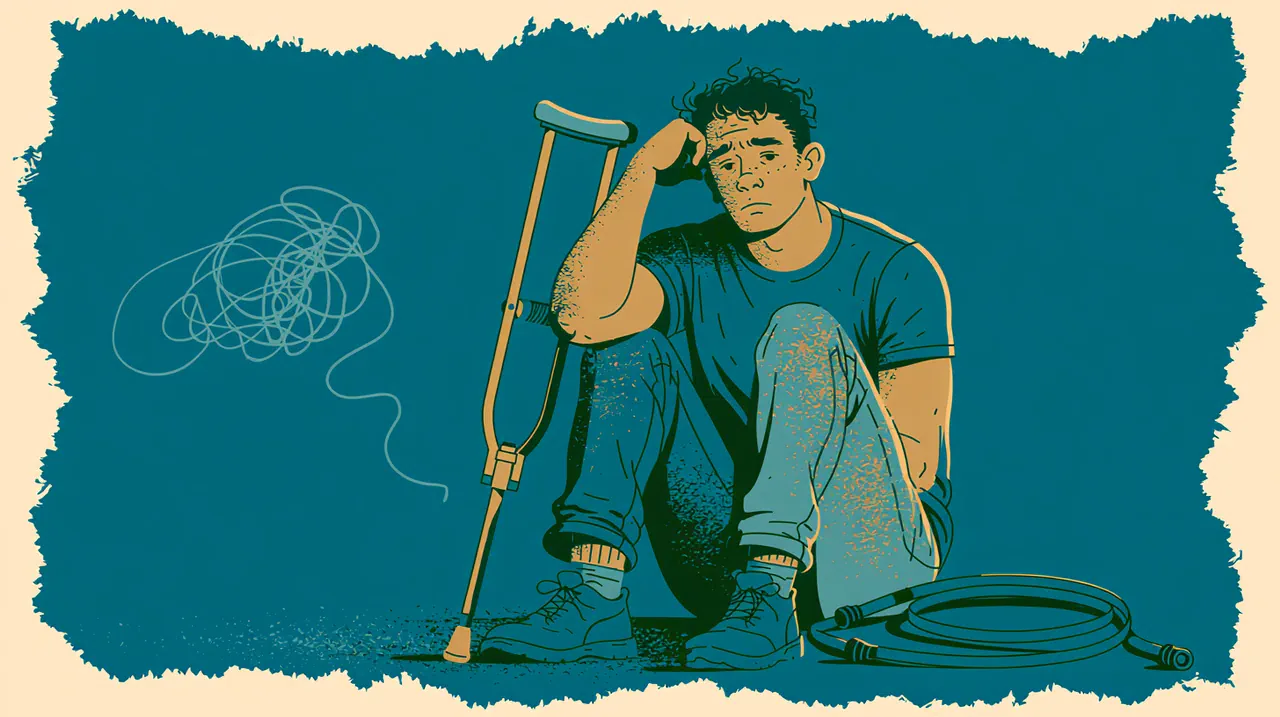
One moment – and everything changes. One wrong move, a popping sound in a joint, a diagnosis. Yesterday you were in the middle of a workout; today you’re planning your weeks around physical therapy appointments. And while your body heals at a snail’s pace, your mind is racing: frustration over every lost week, anger at your own body, envy of everyone who’s allowed to just keep training. The rehab exercises are monotonous, progress is invisible, and on some days you wonder why you’re even putting yourself through all this.
And then there’s that one question no one can answer. “Will I ever be the same again?” The doctors say, “We’ll see,” the physio says, “It depends on how things go,” and you’re stuck in the middle – between hope and fear, between “Of course I can do this!” and the nighttime “What if I can’t?” This life in limbo can feel tougher than the pain itself. Add to that the fear of the movement that injured you – your body flinches before your mind even has a chance to weigh in.
Your sport was never “just a sport.” It was your outlet after tough days, your community, your routine – a big part of who you are. That’s exactly why it hits you so hard – and that’s exactly what the people around you often don’t understand. “Be glad – it’s just a hobby,” “others have it worse,” “then just do something else.” Well-meaning, sure. But every time, it’s a little jab in the heart because it implies your grief doesn’t count.
Maybe you’re already a step further along. The results are clear: your body is ready for a new chapter, and you won’t return to your former level – or only at a cost you’re no longer willing to pay. So now what? Who are you without a competition schedule, without a training group, without the goal that got you out of bed every morning for years? This isn’t a question of motivation. It’s a real transition and a real life-changing event. And both deserve more than just “cheer up.”
I know this path. From the inside.
A torn ACL. Then the surgery that was supposed to fix everything – and instead brought a bacterial infection that set me back. Three more surgeries. Two and a half years of rehab. I know the exercises you eventually come to hate in your sleep, the progress charts that don’t budge, and the nights when you negotiate: with your knee, with fate, with yourself.
And I know the moment that follows: the realisation that competitive sports, as I’d lived them, aren’t coming back. What I didn’t know back then – and what I teach today – is that saying goodbye wasn’t the end of the story. It was the point where a new chapter began.
One thing is important to me here: I can empathise, but my experiences aren’t yours. No two injuries, no two athletic careers, are the same. My story is the reason this programme exists – your journey through it is your own.
Three paths. All of them are progress.
Almost all the support available for sports injuries tells only one story: the comeback. Back on the field, stronger than ever. It’s great when it turns out that way – and honestly: it often does! But what if it doesn’t?
That’s why this programme works with three equally valid paths from the very beginning:
- Comeback – back to your sport, mentally prepared rather than just physically cleared to return.
- Adapted Sport – your sport or a new one, in a form that your body can sustain long-term.
- Conscious Farewell – saying a dignified goodbye to competitive sports and building a life that brings you happiness in its own right.
Which path you take will be decided along the way – based on medical facts, your values, and your life, not on motivational slogans. Sports medicine research, by the way, supports this view: A return isn’t a simple yes or no, but a spectrum. Your goal is to come back in a way that serves your whole life. Your task is to get through this time well and reach the point where your life can carry you forward again.
You will learn…
The programme has two parts and a crossroads. Part 1 guides you through the rehab period. At the crossroads, we take an honest look at where your path is leading – if it ends in a comeback, the programme ends here as well, and it’s a success. Part 2 is for the case that you don’t return to your sport – or don’t return fully: processing loss, finding a new direction, living well.
Part 1: The Rehab Crisis – Staying Mentally Strong Through the Healing Process
When your body takes a break and your mind works overtime. You’ll learn:
- to understand how the injury affects your mental state – frustration, anger, fear and gloomy days aren’t a sign of weakness, but well-documented, normal reactions. And: chronic stress measurably slows healing – mental work isn’t just a wellness extra during rehab.
- Building your toolkit for tough days – breathing, body, and mindfulness techniques for acute moments of frustration and anxiety, plus structure for days when nothing seems to work.
- Replacing the withdrawal from sports – exercise was your most important emotional regulator, and that’s exactly what’s missing now. You’ll build a new repertoire of coping strategies instead of suffering through withdrawal.
- Understanding pain and putting it into perspective – pain doesn’t necessarily mean damage. You’ll learn the difference between rehab pain and a warning sign (the latter always requires a doctor or physical therapist) and break free from the cycle of fear, inactivity, and even more pain.
- Confronting the fear of re-injury – it’s the most common reason why a return to activity fails, and you can change it: Regain trust in movement and your body step by step, rather than forcing yourself or taking it easy forever.
- Sorting through your thoughts – rumination loops, worst-case scenarios, “I can’t do this anymore” limiting mindsets, and the most dangerous yardstick of all: constantly comparing yourself to your pre-injury self.
- Sticking with it without overdoing it – rehab IS your current training: Process goals, small victories, dealing with plateaus and setbacks. And the “fighter’s trap”: More isn’t always better – sometimes it sabotages healing.
- Using mental training like the pros – mental imagery keeps neural pathways and technique active while your body rests. An honest assessment: what visualization has been proven to do – and what it can’t.
- Dealing with the people around you – the thousandth “How’s your knee?” question, well-meaning platitudes, competition posts in your feed. You’ll get answers, boundaries, and strategies.
The Crossroads: Comeback, Adaptation, or Retirement
The big question – no pressure, no sugarcoating.
- when the time is right for this decision – and why you can wait until the storm has passed to choose. A conscious “not yet” with a clear follow-up plan is self-care, not procrastination.
- to decide based on criteria rather than on reflex – medical facts, your body’s signals, cost of living, your joy-to-effort ratio, your values. Together with your medical team, not over their heads.
- Seeing through the investment trap – “But I’ve already put so much into this” can keep you in a struggle that has long since become nothing but painful. What you’ve invested wasn’t for nothing – but it’s not an argument for the future.
- Riding the ambivalence – the back-and-forth between hope and letting go isn’t a sign of weakness, but part of every honest decision.
Part 2: Loss & Change – When Sports Don’t (Quite) Come Back
Real grief, a real fresh start. You’ll learn:
- that your grief is real and justified – the loss of abilities, goals, teammates, and future plans triggers genuine grieving processes, even if no one has died and those around you say, “It’s just sports.” Simply taking this seriously makes a big difference.
- truly processing the loss instead of skipping over it – at your own pace, without a one-size-fits-all template, using tools from grief research, writing, and bodywork. Mixed feelings are allowed too – even the secret relief that hardly anyone voices.
- Saying a dignified goodbye – professionals get a farewell game; amateurs often get nothing. Here, you’ll design your own honorary farewell: honouring your career.
- Who you are – with and without sport – gaining a fresh understanding of the athlete identity that has sustained you for years: what remains, what changes, and what you can now add. Your self-worth isn’t tied to your performance.
- Translating what sports have given you – competition, flow, nature, community, body awareness, pushing your limits? These needs remain. You’ll systematically find new sources to fulfill them, rather than just filling a void.
- Learning to love movement anew – shifting from times, rankings, and personal bests to joy, experience, and togetherness. This doesn’t happen on its own – it’s a conscious inner transformation, and it’s worth it.
- Rebuilding a sense of belonging – as training ends, the people often fade away. Pace your contact with your old team, learn to stand on the sidelines, and find new communities that support you.
- Finding meaning in this story – if you want to – growth after such a turning point is possible and well documented, but it’s an opportunity, not an obligation. No “everything happens for a reason” clichés. Your story, your interpretation, your next chapter.
How things turned out for me
For me, the decision eventually became clear: I was ready to let go of something that had long since been nothing but a source of pain. That sounds more matter-of-fact today than it felt back then – it was a farewell with all that it entailed.
But here’s the part that no one could convincingly tell me back then: Things turned out really well. Today I put my energy into art projects and festivals; I paddle; I climb easier routes – adventures driven by joy rather than a training plan. The pain I used to feel when I thought about sports has been replaced by calm clarity. Not because I’ve forgotten, but because I’ve processed it, made sense of it, and rebuilt myself. It’s exactly this work that I pass on in this programme – as a coach with a systematic approach, not as a story to be copied.
The Next Step
Get to know me. During the free initial consultation (25 minutes, no obligation), you’ll tell me where you’re at right now and what you’re looking for. You’ll learn how I work and what might help you in your situation. Afterward, you can decide at your own pace – no sales pitch, no obligation.
Important Points About the Program
This program does not replace physical therapy – it complements it
Your rehabilitation belongs in the hands of medical professionals and physical therapists. Period. What’s often neglected there is the mental side: staying motivated over months, dealing with fear, pain, and uncertainty, as well as questions about identity and the future. That’s exactly where I come in – as a complement, not a replacement. I generally focus on mental performance rather than physical strain, training clearance, or medical issues; those questions belong with your healthcare professionals, and I actively encourage you to bring them in. Ideally, we’ll even integrate the mental work with your rehab goals – including collaborative goal-setting with your physical therapist.
A Word About Your Comeback
If you’re thinking right now, “But I just want to get back out there and don’t need all that ‘goodbye’ stuff”: Wonderful – then Part 1 is the program for you, and if your comeback is successful, it ends there as a complete success. Part 2 isn’t on your path; it’s there just in case life decides otherwise. Knowing that there’s a good path forward even then, by the way, takes away exactly the kind of pressure that causes many comebacks to fail.
This Program & the Three Subject Areas
Sports Trauma & Rehab is a specialised program that spans my three subject areas: It begins in the midst of a crisis, guides you through an (often unintended) life change, and ends – if you’d like – with the conscious creation of a life that brings happiness even without competitive sports. You can dive into the main programmes at any time; this one stands on its own.
Important Professional Distinction
In my areas of expertise and practice, I clearly distinguish myself from the fields of medicine, physical therapy, psychotherapy, and life and social counselling. This is particularly important for this programme because it deals with injury, pain, and emotional distress. With me, you’ll learn self-help and the skills for self-work – diagnosis, treatment, and rehabilitation of your injury are the responsibility of doctors and physical therapists. If you’re experiencing serious psychological distress such as depression, trauma, or mental illness, psychotherapy and medical care should be your first points of contact. If you’re unsure, please feel free to talk to me about it. Likewise, if issues arise during our work together for which you need active help, we’ll discuss them. Depending on the issue, I’d be happy to put you in touch with appropriate colleagues from my network, while we either pause our training for the time being or continue it alongside their support. Please never hesitate to bring up any overwhelming issues that arise.